






|
What is a Mobile Ad-Hoc Network (MANET)?
MANET stands for Mobile Ad Hoc Network. It is a decentralized type of wireless network where individual devices can connect and communicate with each other without the need for a centralized or pre-existing network infrastructure. In other words, MANETs are self-configuring networks where devices, also called nodes, can form connections and communicate on the go. It is a network in which every node is ready to receive and forward data to other nodes, where every node acts as a host and a router, an endpoint and a relay at the same time. Unlike traditional networks that rely on fixed base stations or infrastructure, mobile ad-hoc networks operate in dynamic and often highly variable environments. The networks form on the fly and are constantly self-configuring. For this reason, these networks are sometimes called on the fly or spontaneous networks. MANET's fundamental feature remains its independence. In fact, MANET is independent because it does not rely on any pre-existing infrastructure. Instead of using a centralized router, each node in the network participates in routing network traffic by forwarding data for other nodes. Data traverses the network by hopping from one network node to another until it reaches its destination. For example, if we compare MANET with DMR, Tetra or P25 networks. We can see that these networks are designed to be geographically static and rely heavily on a fixed infrastructure. Typically, such a network has one node designated as the ‘Master Node’ to maintain the entire network. This Master Node distributes network addresses to all other nodes in the network, and monitors the flow of traffic to decide on the most efficient route. The whole network is dependent on this Master Node. The Master Node in this network is a single point of failure. What happens to the network if the Master Node ceases to work…? 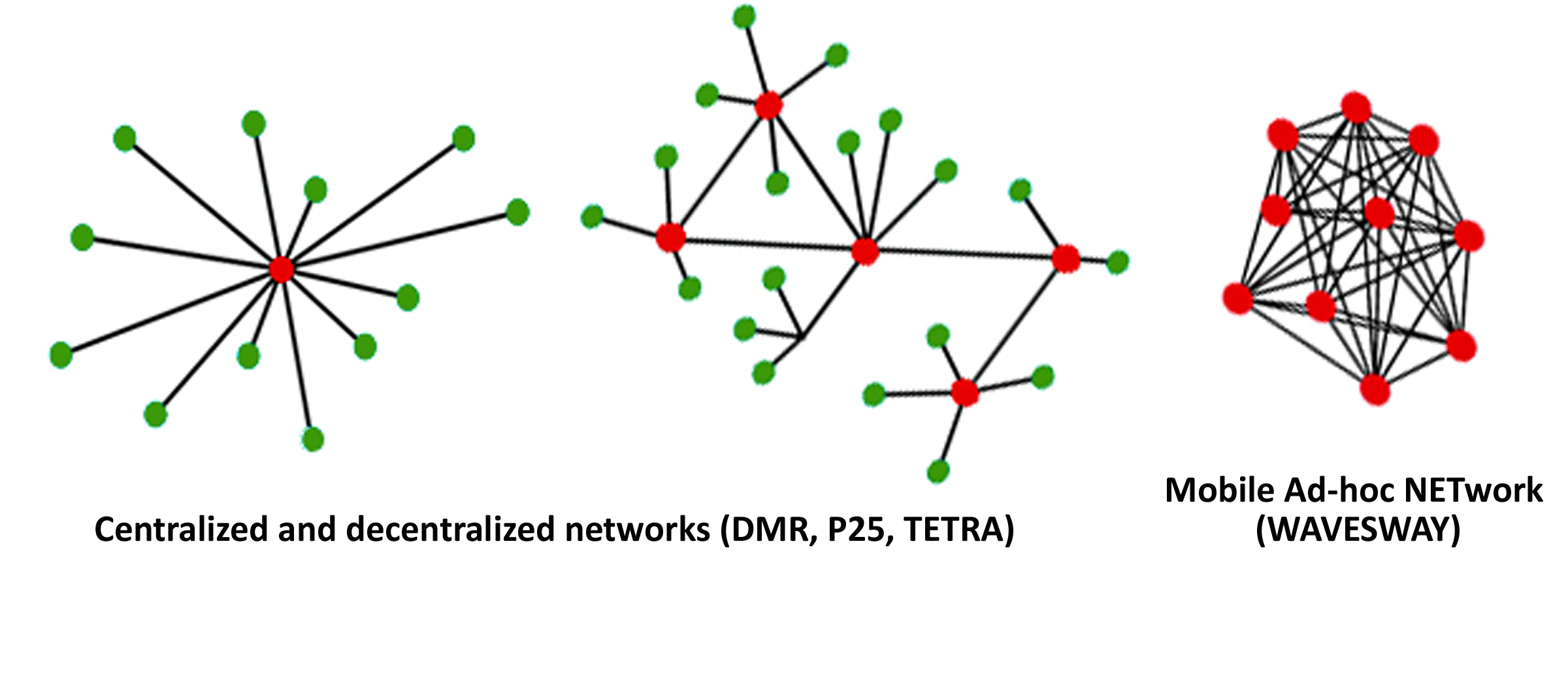 MANET networks are entirely dynamic and use an adaptive routing approach. There is no need for a Master Node to manage the network. All nodes in a MANET work together to route traffic and maintain a robust link. Mobile ad hoc networks use dynamic routing protocols that can adapt to network failures and topology changes. If a node or link fails, the routing protocol will automatically find an alternate route to ensure continued communication. As a result, the likelihood of a single point of failure in a MANET is greatly reduced because data can travel over multiple paths. This makes MANET networks much more resilient than MESH networks, and much less prone to failure. The ability of a MANET network to support this seamless transition of traffic essentially means the network is self-forming and self-healing. Other important features of MANET networks are their easy scalability and dynamic topology. MANET topologies change frequently due to the mobility of nodes. Devices communicate directly with their peers, forming chains to deliver information. They may join or leave the network, resulting in a dynamically changing network infrastructure. The network thus has the ability to reconfigure itself erratically and in real time, depending on how, where, and when other nodes join or leave the network. Therefore, the range of the network is extended each time a new node joins the network. The more nodes in the network, the greater the coverage area. Without fixed infrastructure, nodes can move the network simply by moving themselves. By eliminating the need for fixed infrastructure, MANET networks can be rapidly deployed and have lower management costs.
|