






|
Revolutionizing Underground Mining Communications from WAVESWAY
In the mining industry, efficient, reliable communications are critical to both productivity and safety. Many mining sites are located in remote areas with rocky landscapes, far from traditional communications infrastructure. The sheer scale of mining operations in rugged terrain, underground tunnels and deep pits make communications a serious challenge. Traditional methods that rely on aging, leaky feeder systems or extensive cable systems are too expensive, unreliable and difficult to install, creating the need for innovative solutions. One such solution is the WAVESWAY radio system, which is setting new communication standards in the mining industry. The WAVESWAY introduces a proprietary solution for wireless networking in challenging environments, such as underground mines. Unlike traditional Wi-Fi or cellular networks, WAVESWAY creates a dynamic, self-healing mobile ad hoc network that adapts to changing conditions to ensure reliable communications. All WAVESWAY devices operate within the ISM frequency band and comply with FCC 15.247 and ETSI EN 300-220 standards. They can be used without a license in most countries worldwide. 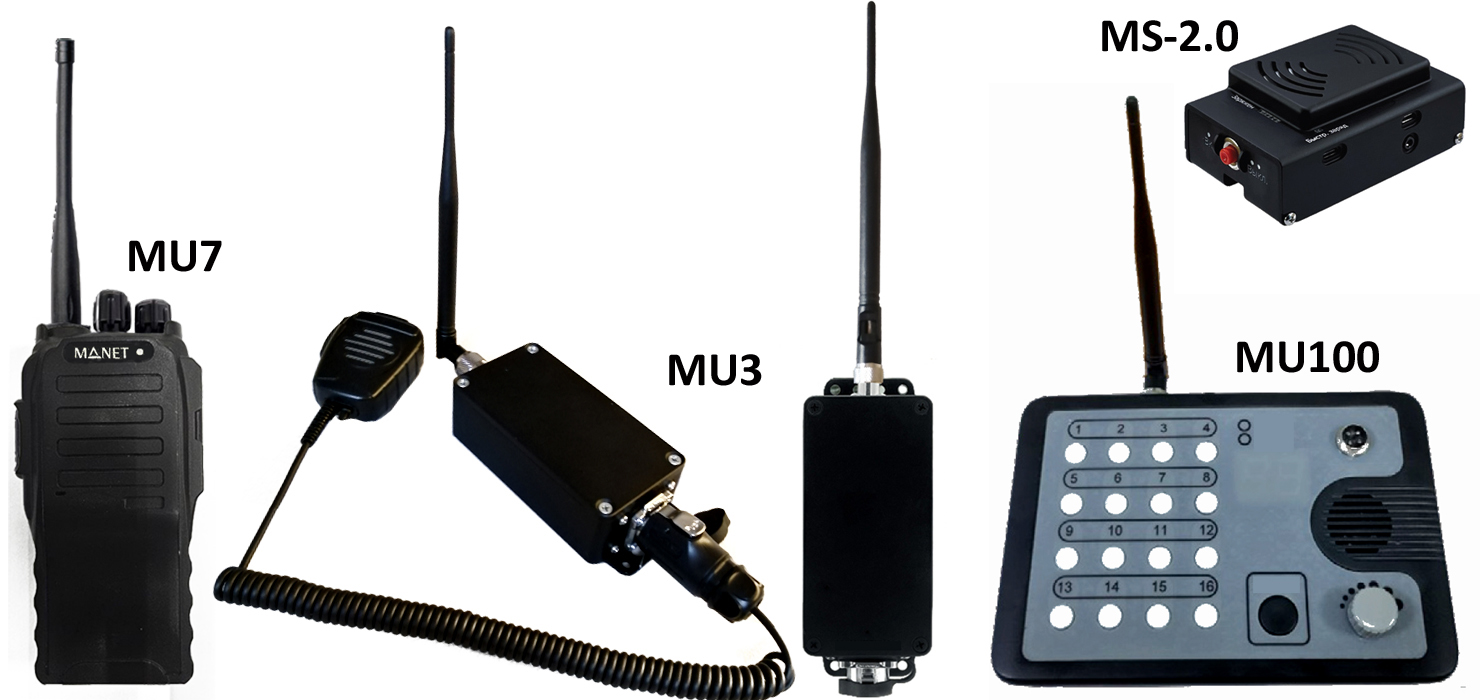 Each of these devices can transmit voice in digital form, geolocation, and information from external sensors such as alarms, door openers, or anything else. Each can also act as a repeater, significantly reducing costs, increasing coverage, and simplifying network organization compared to other digital systems. Let's take a look at how the WAVESWAY radio system works at a mining site. For example, we need to organize reliable communication from the administration building to all parts of the site, both on the surface and underground. We need to record all conversations and transmit network traffic to company headquarters in a city hundreds of miles from the mine. In addition to the communication system, we also need to track the position of all machines and employees in real time and receive information from all sensors. WAVESWAY's equipment is perfectly suited for all of these tasks. Let's start with the underground parts of the site. To cover them with the network, we will use MU3 devices. This device can work as a fixed repeater or, when a headset is connected, as a mobile or fixed radio station. Here we will use this unit as a fixed repeater. It provides a communication range of about 1 km with a standard antenna. Therefore, to cover the entire underground with reliable communication, we only need to install one of these devices at each corner. In most situations, this will be enough. These devices can be connected to an external power supply, or they can operate in stand-alone mode for up to a week because they have built-in high-capacity batteries. In this case, they must be recharged once a week using a power bank. Now, all employees in the underground part of the site have the ability to communicate with each other and with the surface. We will equip the employees with MU7 handheld radios. These are small, lightweight, IP65-protected devices with proven performance in the most demanding environments. And for the machines, we will install MU3 devices, but in a vehicle version. After that, we need to set up communication on the surface of the site. 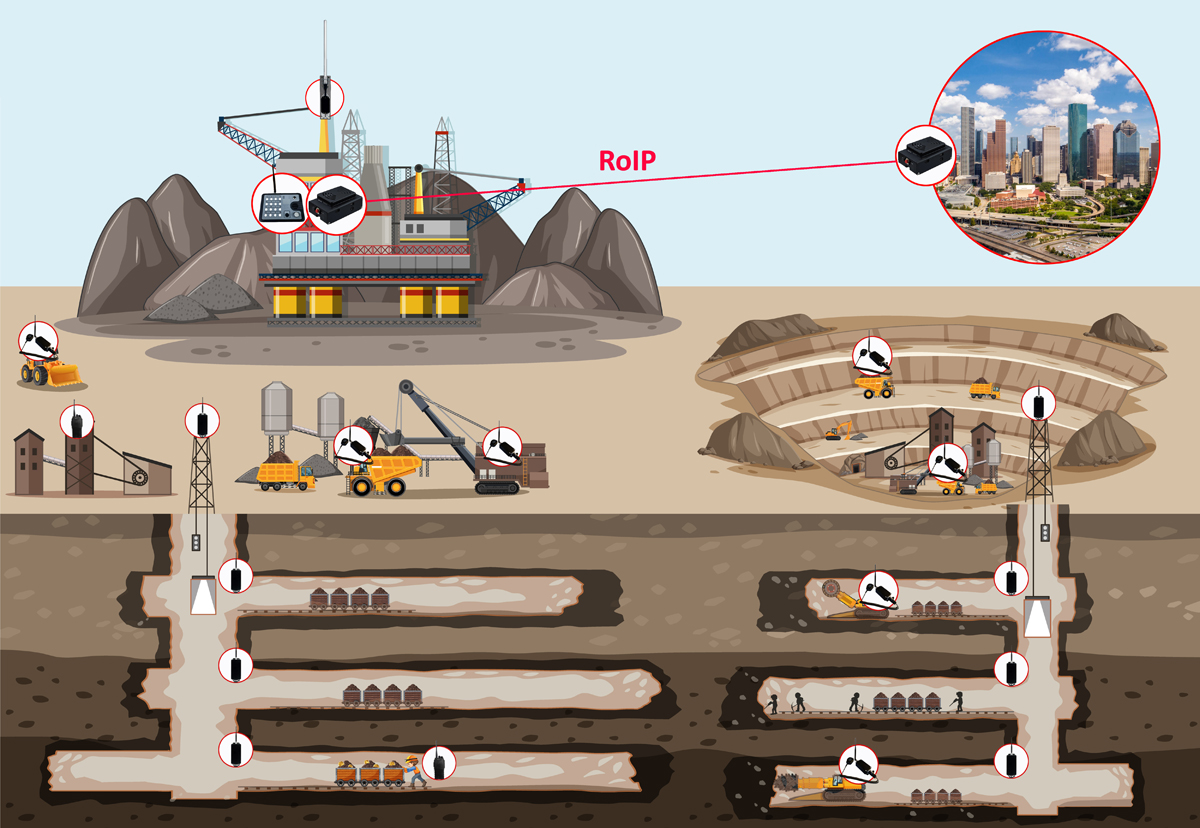 To do this, we will install the MU3 device with a large omnidirectional antenna on the highest point of the site. In most cases, this will be enough to cover the whole area of the site, as this device provides communication coverage within a radius of 20 kilometers. In the case of a large area of the site, a complex terrain or a large number of buildings on the territory, it may be necessary to install more than one such device. The dispatcher's workstation in the administration building will be equipped with an MU100 control panel, a computer with a Monitoring and Control System and an MS-2 Network Gateway. The MU100 allows the dispatcher to monitor communication on all channels, switch between different groups of employees, and make general calls, such as in the event of an alarm. With the Monitoring and Control System, the dispatcher can monitor the status of the radio network, see the signal level between subscribers and the battery charge level of their radios, and track the location of all subscribers in real time. The Monitoring and Control System also allows the dispatcher to receive information from many different sensors installed in the mine and respond quickly to various events. The MS-2 Network Gateway provides the ability to route radio network traffic over public networks (cellular and Internet) or satellite communications. It allows to unite several remote sites into a single radio network and organize direct communication with the headquarters located anywhere in the world. At this point, we can say that the process of creating the network is complete. At a relatively small site, it is possible to organize a network like this in one day. Practice has shown that organizing communication at mines with the WAVESWAY system costs much less than with traditional systems that use leaky feeder or industrial WiFi. In addition, WAVESWAY networks are much more stable because they are based on MANET technology.
|